Document Intelligence · Retrieval Systems
Vectorless Retrieval: When Document Structure Replaces an Embedding Index
Built for a market intelligence platform that continuously reads long regulatory filings, trade news and other internal and external data sources, and extracts a fixed taxonomy of commercially relevant signals. Instead of chunking documents into an embedding index, we preserve their hierarchy as a semantic tree, traverse that structure deterministically, and send only the relevant evidence to the reasoning model.
- Hundreds of pages → 5–20 nodes
- Deterministic traversal narrows each filing to the sections the reasoning model actually needs.
- Understand once, retrieve deterministically
- Semantic interpretation happens at index time. Retrieval itself makes no model call.
- A miss is a config change
- Fix the retrieval vocabulary and re-traverse the cached tree. No re-parse, no redeploy.
A capacity figure appears halfway through a regulatory filing. By itself, it is just a number. Its meaning comes from the section it belongs to, the subsection above it, the process unit being discussed and, sometimes, a qualification several paragraphs away.
That observation shaped the retrieval architecture we eventually put into production. We initially approached the problem in the way many document-intelligence systems are built today: parse the documents, chunk them, generate embeddings, retrieve semantically similar passages, and give those passages to a language model.
It was a reasonable starting point. But after working with the documents and, more importantly, with the questions the system actually needed to answer, we realised we were paying for a property we did not need: general-purpose retrieval over arbitrary queries.
Our questions were not arbitrary. They were known before a document arrived. That allowed us to ask a different architectural question: If the query space is finite, and document structure carries part of the meaning, do we need similarity search at all?
For this workload, our answer was no.
The setting
This work sits inside a market intelligence platform built for a Fortune 500 organization. The platform continuously monitors public regulatory filings for developments that can change the commercial picture: changes in production capacity, changes in what a facility is permitted to produce, new market participants and other defined events. Those developments are surfaced to analysts as structured, scored signals with citations back to the underlying filing.
The source documents are environmental permit filings published by US state agencies, Canadian province agencies or counterparts in other geographies. They routinely run to hundreds, and at times thousands, of pages and arrive continuously. Reading every report end to end is not operationally realistic.
The system therefore has a narrower but demanding job: take each incoming document and determine whether it contains evidence for any signal in a predefined taxonomy, extract that evidence correctly, and preserve enough provenance for an analyst to verify it.
The retrieval problem was partly a structure problem
The first thing we had to recognise was that these documents are not simply long collections of text. They have structure, and that structure carries meaning. Sections nest within sections. Tables describe individual units. Attachments qualify statements in the main filing. A number may only become meaningful when interpreted under the heading several levels above it.
Consider a simplified example:
A text chunk containing only the final line has preserved the words but lost part of the meaning. This matters because conventional RAG normally transforms a document hierarchy into a flat retrieval surface. Whether we use fixed-size windows, recursive splitting or more sophisticated chunking, we eventually produce a collection of passages. We can attach metadata to those passages, but the retrieval primitive remains: Which pieces of text are most similar to this query?
Our problem was slightly different: Which parts of this document belong to the semantic structure relevant to this known signal? That distinction eventually mattered more than our choice of embedding model.
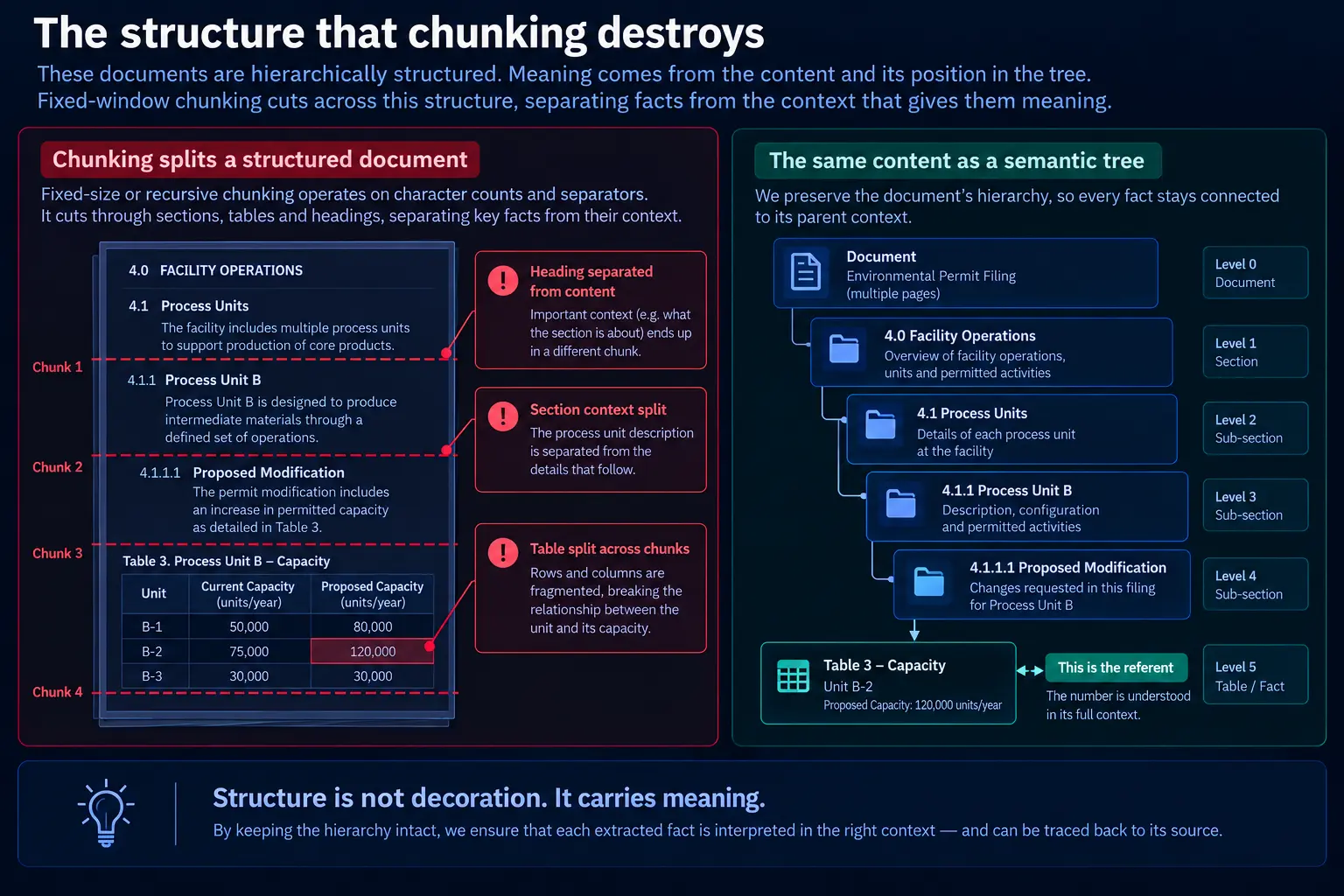
Figure 1. Chunking can separate a fact from the hierarchy that gives it meaning; the semantic tree keeps the parent context attached.
We started with chunk-and-embed
We did not begin by trying to avoid vector search.
Chunk-and-embed was the obvious baseline, and it remains a good architecture when documents are primarily prose, users can ask arbitrary questions, and approximate semantic retrieval is acceptable.
Our workload violated those assumptions in several ways. First, chunk boundaries repeatedly cut through structures we cared about. Smaller windows preserved retrieval specificity but fragmented tables and separated values from contextual headings. Larger windows retained more context but introduced unrelated material around the evidence. Header-aware splitting helped, but a hierarchy represented as metadata on independent passages is still different from retaining the hierarchy itself.
Second, retrieval misses were difficult to diagnose. Suppose a filing contains evidence that should have produced a signal but the relevant passage is not returned among the nearest neighbours. We can measure retrieval performance statistically, tune parameters, change embedding models or modify chunking. What is much harder is answering the engineering question for that individual miss: Why did this exact passage fail to retrieve, and what deterministic change guarantees that the same failure will not recur?
For our use case, missed signals were precisely the failures we wanted to understand. But the decisive observation was simpler: we knew the query set in advance. The system was not answering arbitrary analyst questions. A fixed taxonomy of signal definitions was evaluated against every incoming filing.
Similarity search buys us the ability to retrieve against questions we did not know when the document was indexed. We were maintaining an embedding model, vector index, re-embedding strategy and associated monitoring for an optionality this particular retrieval path did not use. That led to the architecture we run today.
Moving semantic understanding from query time to index time
The central design decision was to move language understanding earlier in the pipeline. Instead of flattening a filing into chunks and reconstructing relevance later through similarity search, we first construct a semantic representation of the document.
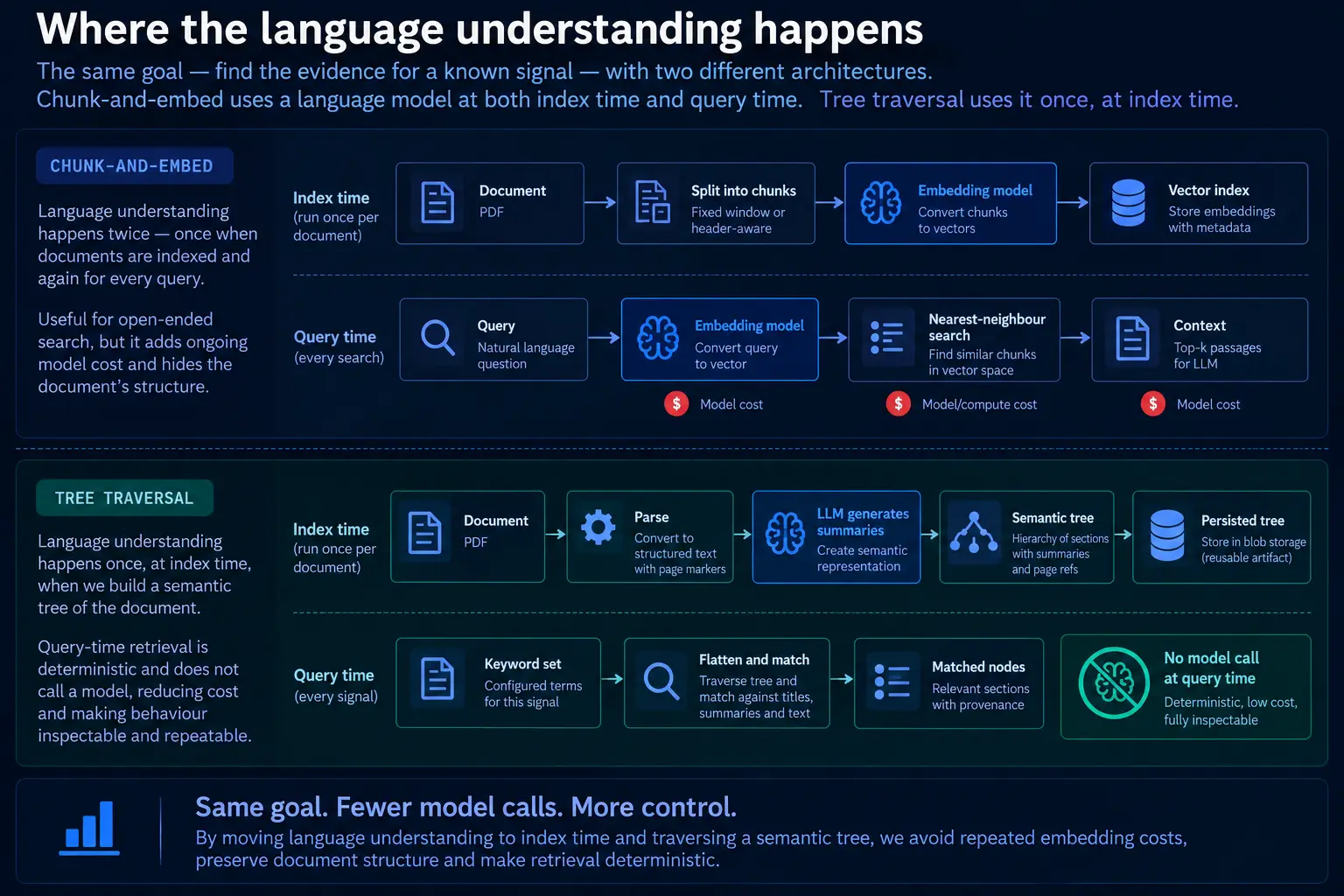
Figure 2. Chunk-and-embed repeats semantic machinery at query time; tree traversal performs semantic interpretation once during indexing and keeps retrieval deterministic thereafter.
The four-stage pipeline · 1 of 4
Preserve structure and provenance during parsing
Azure Document Intelligence converts each PDF into Markdown. During post-processing, we inject explicit page markers derived from the page spans returned by the parsing service. That means page provenance enters the pipeline at the first transformation rather than being reconstructed later.
The resulting Markdown is persisted to blob storage and referenced from the document record. This artifact is also a checkpoint. If parsing has already completed successfully, a retry does not parse the document again.
The four-stage pipeline · 2 of 4
Build a semantic document tree
The Markdown is then converted into a hierarchical JSON tree. Each node contains the section title, its text, page location and an LLM-generated summary. This summary is important. It does more than shorten the node. It creates a normalized semantic description of what that part of the document is about.
A section may never literally contain the phrase “capacity expansion.” But its summary may describe the section in those terms after interpreting the underlying technical language. At that point, semantic interpretation has already happened.
The tree is persisted as another reusable artifact. This changes the economics and behaviour of retrieval: we pay for semantic understanding once when the document is indexed rather than repeatedly whenever a signal definition is evaluated.
The four-stage pipeline · 3 of 4
Retrieve by deterministic traversal
Once the semantic tree exists, the retrieval step itself contains no model call and no embedding lookup. For each signal type, we maintain a set of retrieval terms. The traversal recursively walks the document tree and evaluates those terms against a combination of the node’s title, semantic summary and underlying text. Matching nodes are deduplicated and become the bounded evidence context for the downstream reasoning step.
Conceptually, the path is Document → Semantic Tree → Deterministic Traversal → Relevant Nodes → Reasoning Model, rather than Document → Chunks → Embeddings → Vector Index → Similarity Search → Reasoning Model.
Calling the architecture “keyword search” would undersell what is happening because the matching surface is not simply the raw document. The language model has already interpreted each section during tree construction and produced a semantic summary. Deterministic matching then operates over that enriched representation.
Semantic understanding happens once; retrieval over that understanding is deterministic.
The four-stage pipeline · 4 of 4
Reason and score only on bounded evidence
Removing embeddings did not mean removing language models. It meant being more deliberate about where we use them. Only nodes selected by the deterministic traversal are sent to the reasoning model. For each signal type with matching evidence, the pipeline resolves a versioned prompt, supplies the bounded node context and asks the model for a structured response.
Document metadata is then attached to the extracted signal so that its origin remains traceable. Scoring is deliberately separated from extraction and runs against a different model deployment. It produces an impact score, confidence, rationale and a breakdown across weighted commercial-risk dimensions. Keeping scoring separate gives us another useful architectural boundary: we can modify or replace scoring behaviour without changing document extraction.
The overall pattern is therefore: LLM to build semantic representation once; deterministic code to retrieve repeatedly; LLM to reason over bounded evidence.
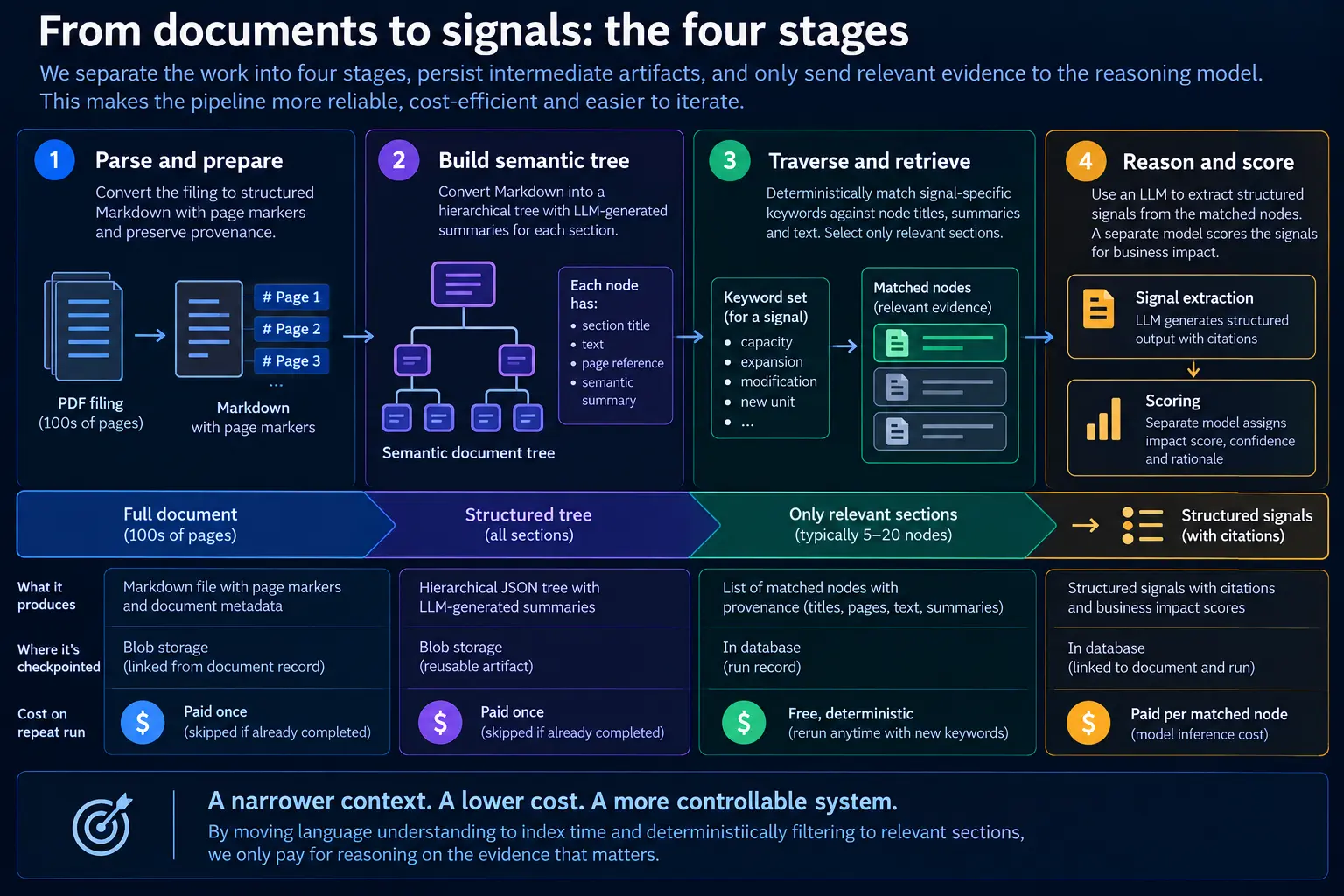
Figure 3. The four production stages make the narrowing of context visible: expensive work is checkpointed, traversal is deterministic, and only matched evidence reaches reasoning and scoring.
The difficult question: what are we missing?
Removing similarity search does not remove retrieval failure. It changes the failure mode. If traversal depends on a configured vocabulary, what happens when a filing expresses a relevant development using language we did not anticipate?
We currently mitigate that in three ways.
First, the semantic summaries absorb some vocabulary variation. The raw filing does not necessarily need to use the same expression as the signal taxonomy if the tree-construction step has already interpreted the section into more conventional language.
Second, retrieval terms are runtime configuration rather than application code. When we encounter terminology the traversal did not recognise, we can update the relevant signal definition and rerun traversal over the already persisted tree. We do not need to parse the PDF again, reconstruct the tree or redeploy the service.
Third, analyst corrections are captured. The feedback layer stores the original generated output, the analyst-edited output and the structural difference between them against the execution trace. Repeated corrections can therefore expose systematic extraction gaps rather than disappearing as unstructured user feedback.
But none of those mechanisms gives us something we still need: a measured recall number.
To calculate true recall, we need a representative set of filings in which analysts have exhaustively labelled every signal that should be found. We do not currently have that evaluation set. That means we can measure execution behaviour, cost, reproducibility and analyst corrections, but we should not claim that deterministic traversal has higher recall than embedding retrieval. That comparison requires evidence we have not yet produced.
What we can say is that the failure is more actionable. When traversal misses because our retrieval vocabulary does not cover a formulation, we can identify the vocabulary gap, modify the configuration and deterministically re-run the affected documents. That repairability was valuable enough for this workload that we accepted the trade.
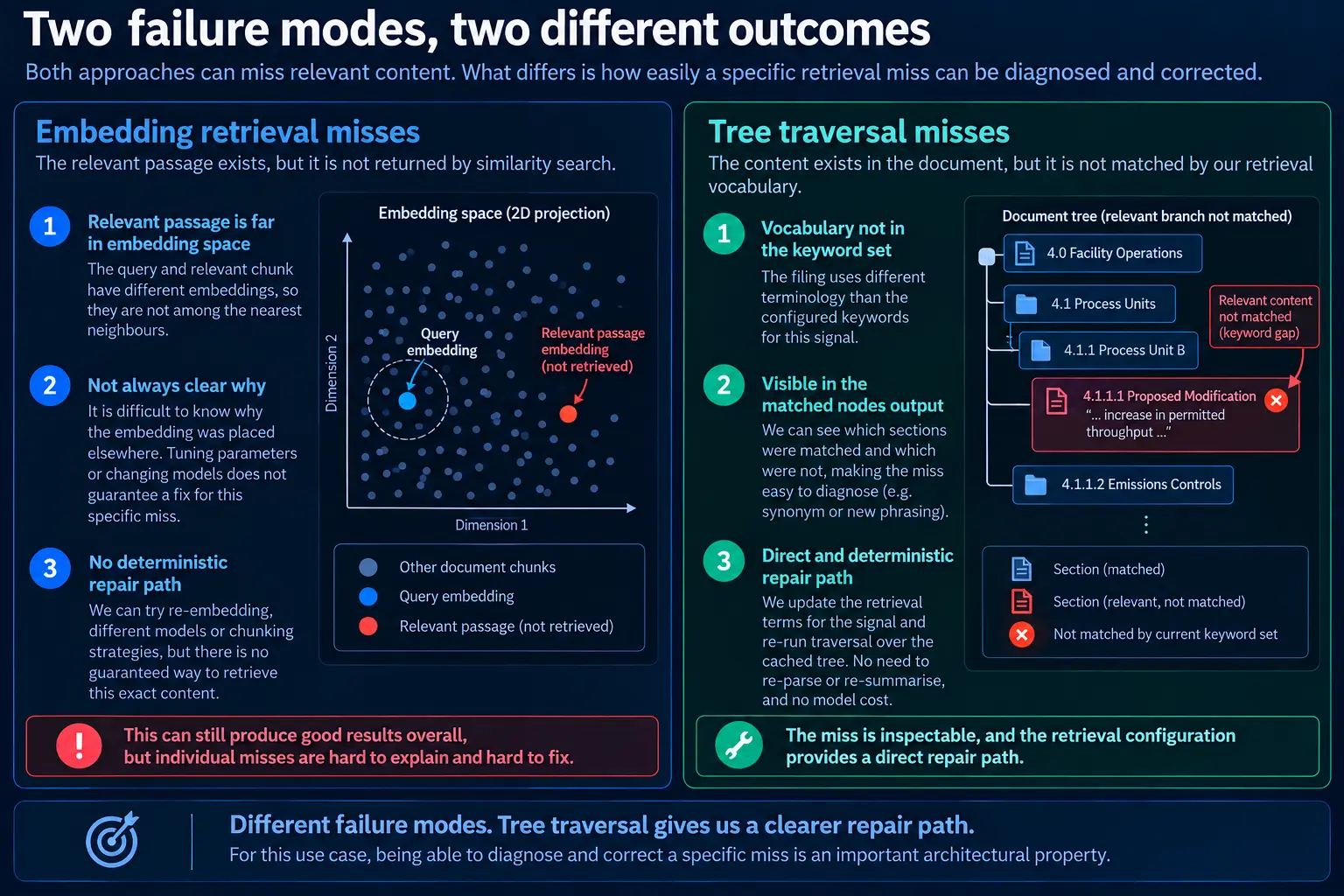
Figure 4. Two retrieval failure modes. The important distinction for this system is inspectability and repairability; comparative recall still requires a labelled evaluation set.
Production engineering mattered as much as retrieval
The retrieval mechanism is only one part of making the pipeline work continuously. The production implementation runs as chained agents within a FastAPI service on Azure Container Apps, with a separate stateless orchestrator controlling document acquisition and processing. Each pipeline phase writes its status to the document run and persists its completed artifact.
That gives us artifact-level checkpointing rather than run-level checkpointing. If PDF parsing succeeds but semantic tree construction fails, a retry does not start from the PDF. If the tree already exists and we change the retrieval taxonomy, we do not pay for either parsing or tree construction again. We simply traverse the cached tree with the new configuration. That property turned out to matter for both reliability and experimentation.
Concurrency is deliberately bounded as well. The orchestrator dispatches document processing under a semaphore rather than allowing every pending document to fan out simultaneously against shared compute quotas. A load spike therefore becomes a queue rather than an outage.
Failures are similarly explicit. Phase state and errors are committed so the orchestrator can distinguish a failed model call from a missing document and apply its retry policy accordingly. Acquisition itself is idempotent through a uniqueness constraint on source URL. Combined, these choices mean the system can retry aggressively without repeatedly paying for successful work or creating duplicate documents.
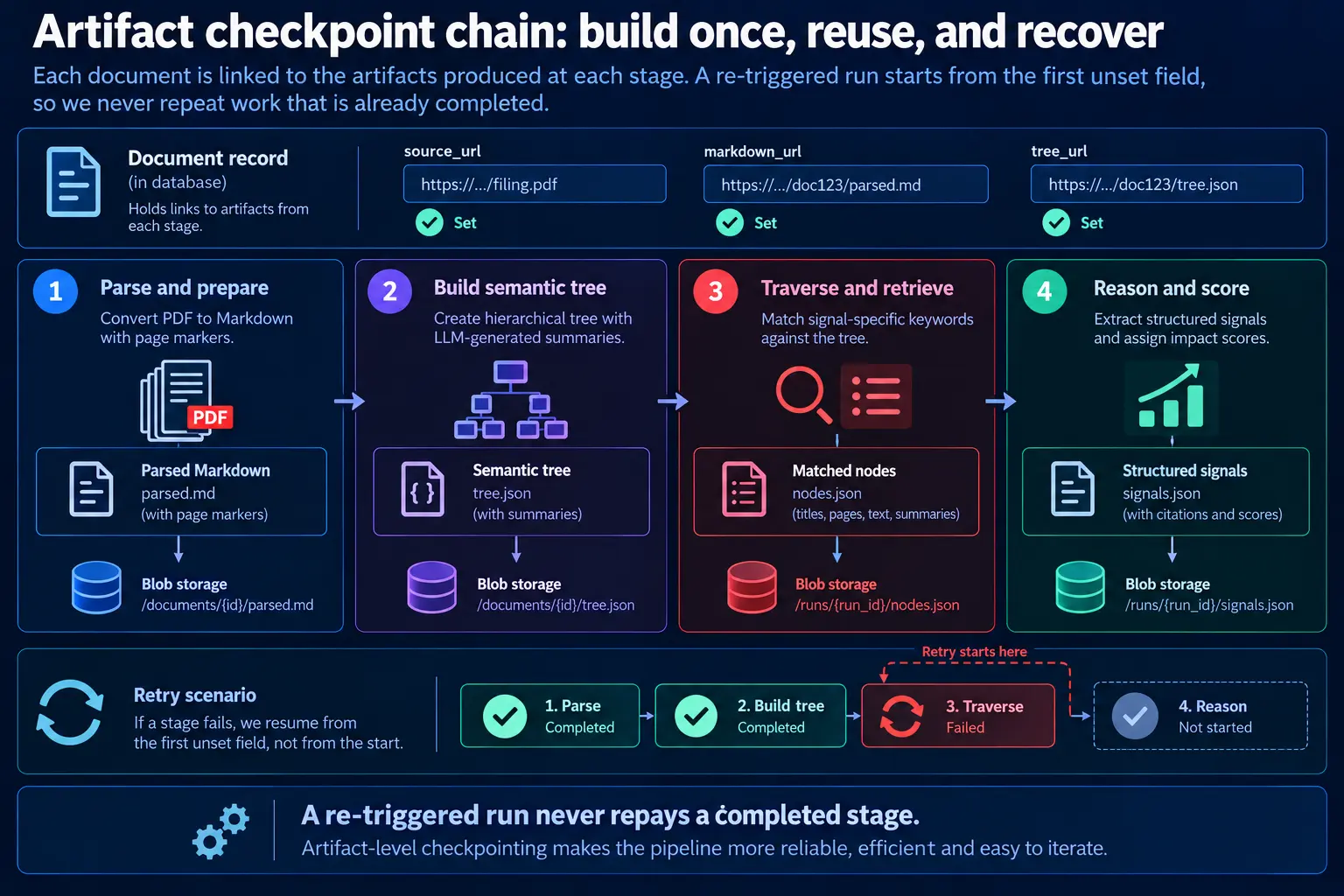
Figure 5. Artifact-level checkpointing lets a re-triggered run resume from the first incomplete stage rather than paying again for work already completed.
Cost became an architectural property, not just a model setting
The largest cost reduction does not come from selecting a cheaper reasoning model. It comes from controlling how much text ever reaches one. Once the semantic tree has been built, deterministic traversal has effectively zero model cost. Sections unrelated to a particular signal never enter that signal’s reasoning context.
That makes traversal both a retrieval mechanism and a spend gate. Every agent records its model, token usage, duration and cost in an execution log. We can therefore inspect where model spend occurs rather than assuming the architecture is cheaper because it appears to make fewer calls. This is another reason we prefer the separation between indexing, retrieval and reasoning. Each stage has a different cost profile and can be optimised independently.
The boundary is deliberate
This architecture is not a general replacement for vector databases, and it is not a general-purpose natural-language search architecture. The design works because two conditions hold simultaneously: the documents contain meaningful hierarchy, and the questions we ask are finite and known in advance. If either condition changes, the trade changes.
If an analyst needs to ask arbitrary questions across the corpus tomorrow, deterministic traversal over a fixed signal taxonomy has no answer path for those questions. We would introduce a semantic retrieval capability alongside the tree. Likewise, we deliberately chose not to use LLM-guided tree navigation in the current retrieval path. A model deciding which branches to explore could plausibly recover relevant sections that deterministic matching misses. But it would also make query-time retrieval nondeterministic and introduce marginal inference cost.
For our current workload, we chose deterministic traversal. That is a design choice, not a claim that deterministic traversal is universally superior.
What we are testing next
The most important next step is not another retrieval technique. It is an evaluation dataset. We need a representative set of documents for which analysts have exhaustively identified every signal that should have been extracted. Only then can we measure recall and compare alternative retrieval strategies rather than reasoning about them qualitatively.
That evaluation set would also give us the basis for two subsequent experiments.
The first is feedback-driven retrieval expansion. We already capture the structural difference between generated and analyst-corrected outputs. With sufficient correction history, repeated misses could be used to propose additions to retrieval vocabulary. The prerequisite is volume. Without enough observations, automated expansion risks learning individual editing preferences rather than systematic retrieval gaps.
The second is LLM-guided navigation as an escalation path. If deterministic traversal returns no relevant nodes, a model could perform a second-pass descent through the already cached tree. That hybrid design is attractive because the expensive path would only execute on exceptional cases.
Until an evaluation set shows that empty traversals frequently correspond to genuine, missed signals, adding a second retrieval mechanism would be architecture ahead of evidence.
What can be generalized
Several lessons from this implementation extend beyond regulatory filings.
- 01Enumerate the query space before choosing the retrieval architecture.Vector search earns its complexity when questions are unknown. A finite taxonomy changes the design space substantially.
- 02Treat document structure as information.If headings, nesting, tables and attachments determine what text means, flattening the document is not a neutral preprocessing step.
- 03Consider where semantic understanding belongs.With predictable queries, performing semantic interpretation once at index time can make subsequent retrieval deterministic and inexpensive.
- 04Put deterministic filtering before expensive reasoning.The model should see the evidence it needs, not the entire document simply because the context window permits it.
- 05Persist expensive intermediate artifacts.A parsed document and semantic tree are reusable assets. Checkpointing them makes retries, taxonomy changes and retrieval experiments considerably cheaper.
- 06Optimise for diagnosability as well as aggregate accuracy.In human-reviewed systems, being able to understand and permanently repair a miss can be an important architectural property.
- 07Do not generalise beyond the evidence.We can demonstrate deterministic execution, bounded model context and repairable retrieval behaviour. Claims about comparative recall require the labelled evaluation set we are still building.
The broader lesson is not that embeddings or vector databases are unnecessary. It is that retrieval architecture should follow the shape of the information and the shape of the questions.
When the questions are open-ended, semantic search earns its place. When the questions are known and the document already contains a meaningful hierarchy, preserving and traversing that structure can be the simpler – and more inspectable – architecture. Before building a retrieval system to search everything, it is worth asking whether you already know what you are looking for.
Keep reading
We Trained a Small Model to Detect Sensitive Data – Without Sending That Data Anywhere
Read the paper →Partners






Investors